The Cost of Uncertainty in Ethereum's PBS Hot Path
Ethereum is organized around a commodity market for blockspace. Each slot, builders compete to assemble the most valuable block and submit their corresponding bids to an auction where the best bid wins. That is how an efficient market should work. But that is not what happens in practice, and the reason runs deeper than most people realize.
Propagation variance, the inconsistency in how long data takes to reach different parts of the network, does more than slow things down: it reshapes incentives across the entire block supply chain, with measurable consequences on market efficiency.
The Mechanism
Consider a user swapping 10 ETH on Uniswap through a protected RPC. His transaction lands in a builder's private mempool, gets simulated, but the state is contentious so the builder holds it. At the last moment he finds a way to include it in the block, creates a new bid, and sends it up through a relay to the proposer. But it arrives 60ms after the proposer had already committed to another block. Our user’s transaction will now land in slot n+1 instead of slot n.
From the user's perspective, Ethereum was slow. From the market's perspective, something more specific happened: blockspace was not allocated to its most valuable use.

This is not an edge case. In PBS, the proposer does not wait for the optimal block. They commit to whatever is available when their cutoff triggers. A bid that arrives milliseconds later simply does not exist from the proposer's point of view. The outcomes are binary. The same logic applies at the consensus layer: a proposer who gets a block to 40% of stake before the 4-second mark will be included and rewarded. A proposer who misses it risks a reorg. An attester who votes correctly before the 8-second deadline earns the full reward. An attester who votes late loses it.
Ethereum does not reward averages.
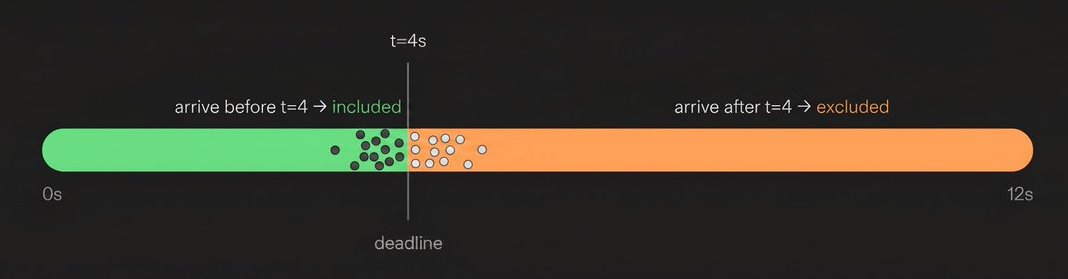
The critical variable is not latency itself, it is variance. A consistent 100ms offset is manageable. PBS participants can calibrate around a known delay. The problem is unpredictability: a message that sometimes arrives early and sometimes arrives late, with no way to know in advance which one. That unpredictability is what makes optimization difficult.
Hedging Makes It Worse
Faced with propagation variance, every PBS participant adapts rationally. Proposers set their cutoff earlier than necessary to avoid missing their slot or falling back on a vanilla block (a locally built block with no MEV), at the expense of higher-value bids that arrive too late to be considered. Attesters accept a lower probability of correct head votes. Transaction originators overpay to improve their odds of inclusion.
Each of these adaptations is the right decision for the individual actor under uncertainty. Together they make the problem worse. High-frequency bid submissions around proposer cutoffs concentrate load at exactly the point in the slot where the system is already under maximum pressure. Relays, sitting between builders and proposers, absorb that burst of competing bids precisely when delivery speed matters most. That load increases propagation variance. Higher variance tightens deadline uncertainty further.The hedging amplifies the very uncertainty it was trying to mitigate.
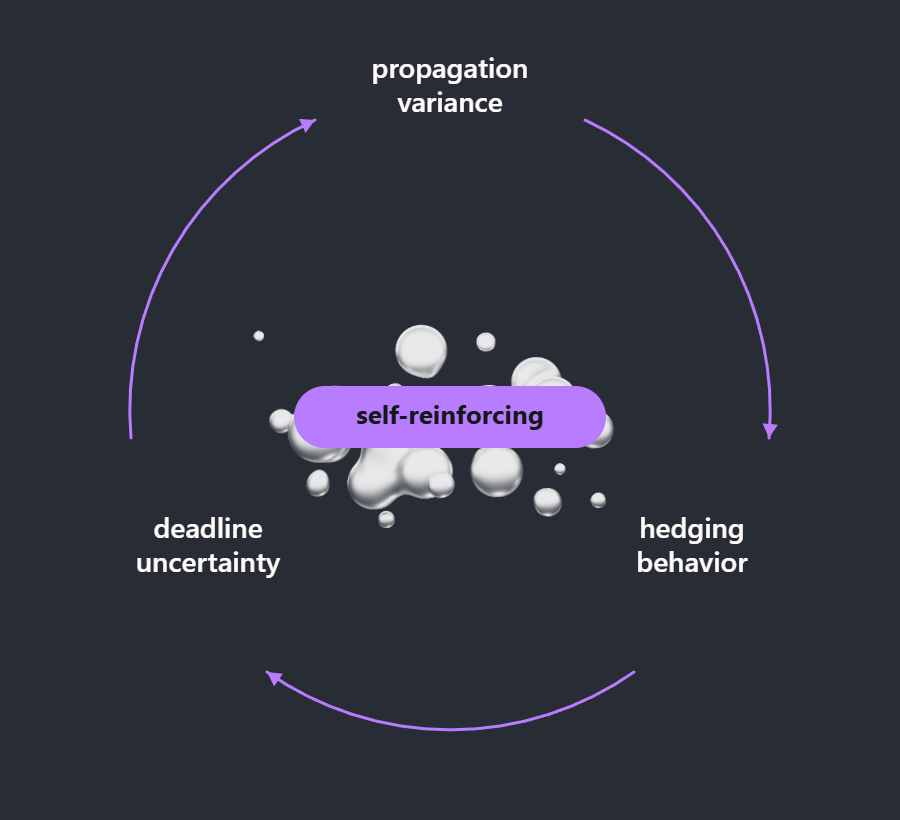
The feedback loop has a geographic expression. K. Mensah et al. observed that Ethereum's core business is the production and sale of blockspace. In a well-functioning blockspace market, the scarce resource is block value. In the current environment, the scarce resource is reliable delivery under uncertainty. Validator concentration around the Atlantic corridor is an economic response rather than an infrastructure coincidence: geographic proximity to the dominant relay and builder infrastructure reduces exposure to propagation variance. The system rewards whoever can deliver reliably, not whoever produces the highest-value block. Research modeling this concentration has found that the current liveness coefficient of Ethereum is trending toward one, where a single regional outage would be sufficient to halt the chain.
What This Costs
In a study conducted by the Optimum team, one week of bid and block data was analyzed across the execution and consensus layers to put a number on what that market inefficiency costs to the participants.
On the execution side, we ran the counterfactual: what would proposers have captured by delaying their cutoff by 150 milliseconds?
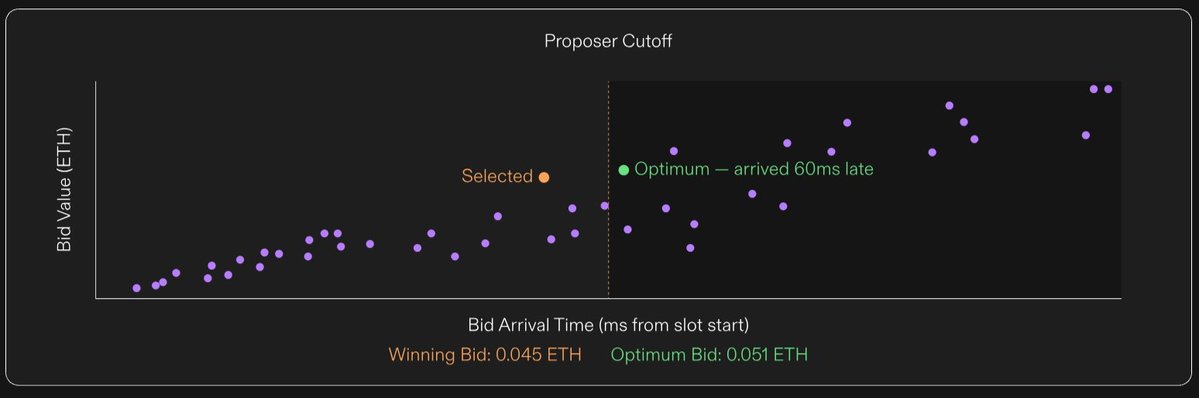
The data showed a 16% average increase in bid value, with roughly 30% of bids showing more than 30% uplift, amounting to around 190 ETH in collective revenue left uncaptured that week, approximately $400K at the time.
At the consensus layer the cost takes a different form. Head vote accuracy currently sits below what the protocol ceiling allows. With 150ms of additional slot time, accuracy could reach 99.1%, closing more than half the gap to the ceiling. For the top five staking operators, the APR impact is approximately +1.97%, translating to roughly $6M in combined annual gain. The network-level estimate, measured in consensus rewards foregone, is approximately 2,000 ETH annually.
The data across both layers points to the same conclusion: participants hedge because the rational response to variance is to protect against the worst case, not optimize for the best. This dynamic has been documented in the context of timing games by Schwarz-Schilling et al. and T. Wahrstätter.
What Fixing It Actually Means
The standard framing for improving propagation is: lower latency, higher throughput, better peer connectivity. Those are relevant engineering targets. The market structure framing points to a different target: reduce variance enough that PBS participants no longer have a rational incentive to hedge.
When delivery is predictable, the tradeoff changes. Proposers can wait longer for higher-value bids without increasing their reorg risk. Attesters get blocks earlier and vote more accurately. Builders can concentrate on block quality. The market starts clearing on value again.
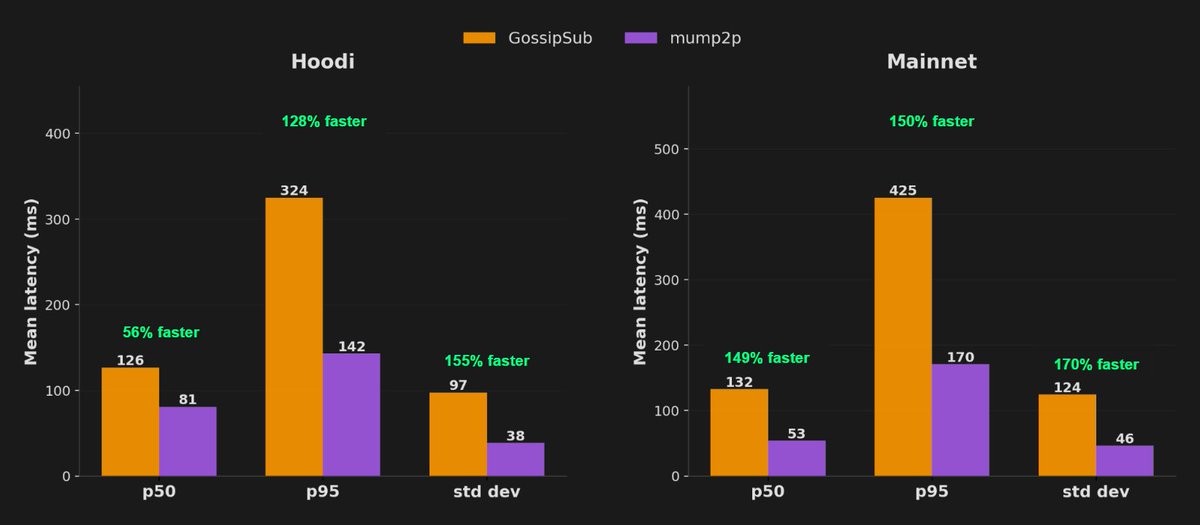
We built mump2p to pursue that target. It implements RLNC, Random Linear Network Coding, in Ethereum's gossip layer. RLNC was co-invented by Optimum's CEO and co-founder Muriel Médard at MIT. The property of RLNC that matters here is that every received chunk contributes to decoding: delivery is faster, more uniform across the entire network, and more reliable under deadline pressure.In a benchmark network of up to 90 nodes, mump2p delivers 150% faster p95 latency than GossipSub and approximately 7x lower propagation variance. The protocol is currently being tested with major node operators across Hoodi testnet and Ethereum mainnet.
What Comes Next
The Ethereum roadmap increases the pressure we have described. PeerDAS went live last year, and independent studies from EthPandaOps, MigaLabs, and Chainbound have confirmed that as payload sizes grow, head vote accuracy drops, missed slot rates climb, and attestation quality worsens. Every upgrade that increases data propagation requirements demands a propagation layer that can absorb the additional variance without forcing participants to hedge further.
The blob market tells the same story. Despite successive capacity increases, the network is operating well below its target blob count, and miss rates spike at high blob loads. Blob-carrying transactions offer additional revenue, but for actors already exposed to propagation variance, the added risk is not always worth it. Underutilization is not a demand problem. It is the market responding to the cost of uncertainty.
The blockspace market Ethereum has built is fundamentally sound. What we are working on at Optimum is closing the gap between what it delivers today and what it could. That means reducing propagation variance enough that hedging is no longer the rational choice.
Thanks to Moritz Grundei and Slobodan Sudaric-Hefner for their collaboration on the research and analysis that underpins this post, and for their feedback.
This post is based on a talk given at EthCC, April 2026, Cannes: “The Cost of Uncertainty: Tail Latency in Ethereum’s PBS Hot Path”available on YouTube. The underlying data is from our research on the effects of latency reduction on ETH staking revenue, available on our blog. Our paper introducing a pricing model for latency in deadline-driven systems is available at arxiv.org/abs/2603.20426. If you operate validators or build blocks and want to explore what value can be unlocked for you by reducing propagation variance, reach out.