

Co-Founders

Kent Lin
Kent Lin drives Optimum’s adoption and ecosystem growth by overseeing business development, tokenomics, and fundraising efforts. He is a former Partner at GSRV, a $4B VC, and a Harvard MBA dropout who also served as President of the Harvard Blockchain Club. Additionally, he is the founder of the McKinsey Crypto DAO, a community of over 200 McKinsey alumni active in Web3.



Prof. Muriel Médard
Prof. Muriel Médard is Optimum's CEO and the NEC Chair at MIT EECS, ranked #1 globally in Network Coding and co-inventor of Random Linear Network Coding (RLNC). Her accolades include membership in the US National Academy of Engineering (2020), membership in the US National Academy of Inventors (2018), leading Network Coding & Reliable Communications, and a tenure as the former IEEE Information Theory Society President.

Dr. Kishori Konwar
Dr. Kishori Konwar brings deep expertise in distributed systems, coding theory, and AI to Optimum. He is a former Senior Engineer and Scientist at Meta, completed his Postdoctoral fellowship in Network Coding at MIT, and has experience as an Ex-Quant at Goldman Sachs.
Advisors

Prof. Nancy Lynch
Published the first mathematical proof of Byzantine Fault Tolerance (BFT) in 1985 — the security property every blockchain consensus protocol is built on. Created the DLS algorithm in 1988, which Tendermint and Ethereum’s consensus protocols descend from.
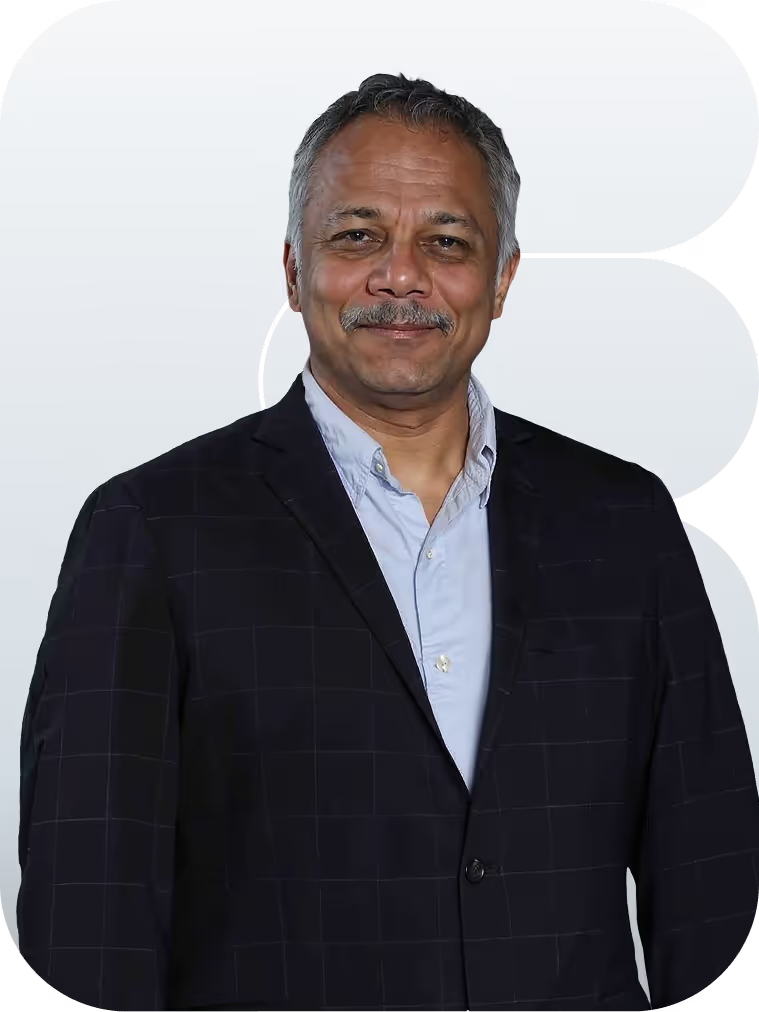
Prof. Sriram Viswanath
NSF Career Award recipient. 2005 IEEE Joint IT/ComSoc Best Paper Award. Research in information theory, wireless communications, and network science.
Team
RLNC Timeline
Network coding invented
Ahlswede, Cai, Li, and Yeung prove that intermediate network nodes can combine data rather than just forward it - achieving the theoretical maximum throughput. The field of network coding is born.

RLNC invented at MIT
Prof. Médard and colleagues introduce Random Linear Network Coding: a practical, fully decentralised form of network coding where nodes independently generate random linear combinations of received packets. No coordination. No central authority. Provably optimal.
Landmark IEEE publication
The foundational RLNC paper is published in IEEE Transactions on Information Theory. It becomes the standard reference for network coding in decentralized systems.
IEEE Fellow
Prof. Médard elected Fellow of the IEEE for contributions to wideband wireless fading channels and network coding - the first major institutional recognition of RLNC's significance.
Dual IEEE recognition
RLNC-related work receives both the IEEE Communication Society and Information Theory Society Joint Paper Award, and the William R. Bennett Prize in Communications Networking in the same year.
ACM SIGCOMM Test of Time
RLNC research from the 2000s receives the ACM SIGCOMM Test of Time Paper Award, recognising networking research with lasting real-world impact.
National Academy of Inventors Fellow
Prof. Médard was elected a Fellow of the US National Academy of Inventors.
US National Academy of Engineering
Prof. Médard elected to the US National Academy of Engineering - the highest professional honour for engineers in the United States.
American Academy of Arts and Sciences
Prof. Médard was elected Fellow of the American Academy of Arts and Sciences. “Founded in 1780, the American Academy of Arts and Sciences honors excellence and convenes leaders from every field of human endeavor”.
IEEE Koji Kobayashi Award
Prof. Médard receives the IEEE Koji Kobayashi Computers and Communications Award for contributions to network coding, optical networks, and wireless communications.
German National Academy of Science - Leopoldina
Prof. Médard was elected to the German National Academy of Science - Leopoldina.
Optimum founded
Prof. Médard co-founds Optimum with Dr. Kishori Konwar and Kent Lin to apply RLNC to blockchain data propagation.
Optimum’s $11M seed round
Seed round led by 1kx. Participants include Robot Ventures, Finality Capital, Spartan, CMT Digital, SNZ, Triton Capital, Big Brain, CMS, LongHash, NGC, Animoca, GSR, Caladan, Reforge, and others. Announced at Consensus Toronto 2025.
Optimum Private testnet
40 validators, $24B+ ETH stake connected, Optimum launches private testnet with 40 validator partners including Everstake, Kiln, Bunker, P2P, InfStones, Luganodes, Alchemy, Blockdaemon, and Nethermind.
Royal Academy of Engineering Fellow
Prof. Médard was elected Fellow of the Royal Academy of Engineering.
IEEE Richard W. Hamming Medal
Prof. Médard receives the 2026 IEEE Richard W. Hamming Medal for contributions to coding for reliable communications and networking.
Coming soon: Optimum Mainnet
Backed by the best
It was obvious from our first interaction with the team that the technology around RLNC has far-reaching potential. It’s been impressive to see the Optimum team adapt their core innovations over the past year to solve critical bottlenecks in decentralised networks and supercharge all blockchains.
Wei Dai
