Flexnodes: A Global Network of Data Accelerators
Blockchain speed and throughput depends heavily on how fast and efficiently validators can communicate. They propose blocks, send them around to all the other validators, and agree on the updated state of the chain to achieve consensus. What if you could help them out? Use your own internet connected device to speed up how fast all that crucial block data reaches every validator? Get rewarded for supplying your bandwidth to accelerate blockchains? This is the idea behind Flexnodes, the foundation of Optimum’s flagship fast data propagation protocol and future products like DeRAM for data storage.
Tldr:
- Flexnodes are a global network of nodes that enhance Optimum’s data propagation and (future) data storage capabilities
- Any internet connected device can become a Flexnode by running Optimum’s Flexnode software
- Operation is incentivized by a “Latency Marketplace” rewarding operators for contributing their bandwidth to the network
- As Optimum expands to more chains and use cases, Flexnodes will be able to serve them all and earn from multiple revenue streams
Network Coded Data Propagation
For those unfamiliar with Optimum data propagation it leverages Random Linear Network Coding (RLNC) to speed up communication between nodes in decentralized networks. Our first implementation of this fast propagation protocol is mump2p on Ethereum. RLNC shards block data into smaller pieces and encodes the pieces into math equations which can travel between nodes much faster and more efficiently than the raw block data. Once a node hits a certain threshold of equations collected it can decode the full block. That’s where Flexnodes come in, as a new data movement primitive designed to get equations to nodes faster (they’ll also play a crucial role in future data storage products down the line). Now that we have a system where propagation latency depends on how fast all the validators can get enough equations, we can optimize for that. The two factors involved are bandwidth (how many equations can be sent per unit of time) and location (physical distance adds latency as data travels across the internet). By setting up a network of Flexnodes operated around the world we can add bandwidth to send more equations and reduce the distance data has to travel to reach its ultimate destination of each validator. This global Flexnode network can be achieved by incentivizing people to become operators, which simply involves running the Flexnode software on any internet connected device.
A Latency Marketplace
Faster propagation makes validators more profitable. Specifically, it reduces missed slots and attestations, lowers the chance of orphaned blocks, and creates some notable MEV advantages. Given the value that validators can generate from faster data propagation, we can create a marketplace where validators will pay for the equations they need and Flexnode operators can be compensated for providing them. Bigger pie and everyone can get a piece, that’s the latency marketplace at its core. Just think about how much time your pc, phone, or laptop spends idly connected to the internet, all that extra bandwidth can be put to use speeding up blockchains and earning from it.

Any Internet Connected Device?
That’s the plan. RLNC powered data propagation has super low hardware requirements, so our long term vision is that Flexnodes can be packaged into a non-technical user interface (think app, browser extension, wallet integration). Anyone can supply their idle internet bandwidth to accelerate blockchain networking and earn rewards commensurate with their contribution. In the short term we’re looking at a much more controlled rollout, likely starting with our existing validator partners as operators. This will progress through a phased testnet focused on data collection and fine tuning. Following successful testing and deployment of Flexnodes we will gradually introduce ways for the larger community to take part in the network. We’re exploring ways to enable wider participation in the testnet beyond just validator partners. Nothing is set in stone yet, but keep an eye out.
Non-technical Tech Overview
Flexnodes are fast forwarding points in the Optimum Network. They operate like normal network peers, picking up block data via a gateway and then performing the sharding and coding processes to produce equations. As soon as the first equation is produced it can immediately be forwarded around the network to validator peers that need equations to decode the block. Validators will keep signaling that they need equations from Flexnodes until the decoding threshold is hit. At the same time a Flexnode is forwarding equations it is also producing new equation variants through RLNC’s recoding capabilities. Sending out these additional equations speeds up the process of any validator collecting the requisite amount for decoding.
More bandwidth to send equations + more equation variants make Flexnodes a force multiplier for Optimum’s fast data propagation protocols like mump2p.
Multichain and Multiproduct
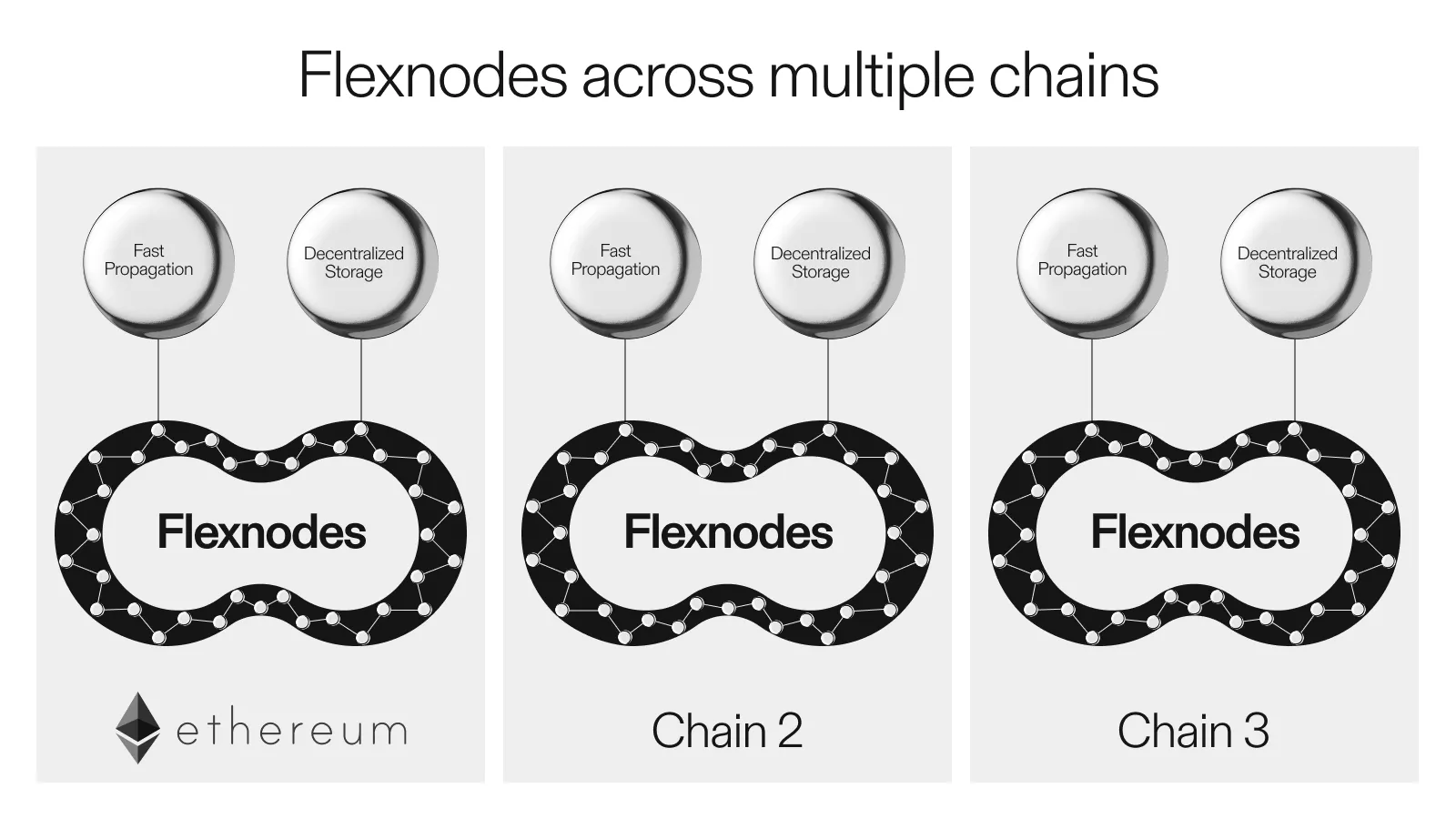
We touched on this earlier, but fast propagation is only the first of Optimum’s products and Ethereum is the first of many chains on which we plan to launch products. What this means for Flexnodes is that they will be able to:
- Serve multiple chains
- Enhance multiple RLNC use cases (propagation, storage, and more)
- Earn revenue from multiple use cases on multiple chains
There’s a massive amount of data that chains need to move, and it’s only going to grow as the worldwide internet economy increasingly adopts blockchain rails. We’re building the infrastructure to handle planetary scale chains and we want you to help us operate it to maximum potential.
Thank you for your interest in Flexnodes. If you made it this far we can only assume you’d like to take part in the future of blockchain scaling. Drop us your email to get on the mailing list for future Flexnode updates.