mump2p: Unlocking Next-Gen Performance for Tomorrow’s Killer Apps
Blockchains power everything from simple payments to complex financial markets, from AI training to inferencing. As the use cases grow more demanding, existing methods for sharing data between nodes haven’t been able to keep up—networks get congested and slow down under heavy load. Developers with ambitious, latency-sensitive, large-scale ideas actively avoid using blockchains despite their benefits because of these scalability constraints. mump2p fixes this by coding data into random linear equations. The result: faster, more reliable block and transaction delivery for everyone involved.
In our previous post (needs backlink once live) we walked through how validators can leverage mump2p alongside their existing software and saw early test results showing 50%+ latency improvements. This post builds on that foundation and dives into the ways mump2p improves blockchain performance so new use cases can thrive, exploring the impacts it can have for DeFi and DePIN in particular.
Execution—i.e., the computation performed locally on each node—on major Layer-1s today is capable of keeping up with demand. Data propagation across the network is the current bottleneck. Fast, predictable block and blob propagation matters for validator economics, network resilience, and overall scalability. mump2p alleviates this bottleneck by significantly reducing redundant network traffic and cutting end-to-end delays
Execution is not the bottleneck. Data propagation is.
Gossipsub is capping performance of many chains today (Ethereum included).
These graphs shows how much bandwidth and latency gossipsub is leaving on the table, relative to optimized propagation like OptimumP2P.
Ethereum relies on protocols like devp2p and libp2p (Gossipsub), for its networking stack. Every block and blob is redundantly relayed to every peer, which can waste bandwidth and introduce unpredictable latency—especially as blob sizes grow as they did post-Pectra upgrade.
mump2p Benefits:
Reduced redundant traffic: Small, coded pieces avoid sending full blobs to every peer, freeing up capacity for larger blocks or more blobs per block.
Low, Predictable Latency: mump2p testnet has shown significantly less latency and improved consistency when sending different blob sizes at various publishing rates vs Gossipsub.
Sub-Second State Sync: Consistent propagation times empower latency-sensitive apps (e.g., high-frequency trading, AIML) to run smoothly on Ethereum.
Faster Finality: With blocks arriving reliably and quickly, the time to reach consensus shortens.
For testnet conditions with 36 nodes mump2p is delivering 4, 6, and 10MB blocks per second all at ~1 sec delay. Gossipsub delivers 4MB blocks at 1.6 sec delay (60% latency increase), 6MB blocks at 2.6 sec delay (160% latency increase), and cannot consistently deliver 10MB blocks (2000+% latency increase).
𝐏𝐑𝐄𝐒𝐄𝐍𝐓𝐈𝐍𝐆: The first look at OptimumP2P in action
Test runs vs. Gossipsub show over 50% lower latency when delivering an average block sized message! pic.twitter.com/gGlFCdpgYC
Current Approach: Turbine is a multi-layer block propagation mechanism used by a Solana cluster to broadcast ledger entries to all nodes. More recently, Anza introduced Alpenglow with an upgrade to Turbine called Rotor. Rotor reduces some tree depth, but it still relies on Reed-Solomon code, resulting in redundant retransmissions and suffers loss accumulation, creating bandwidth waste and variable slot times.
Last month, we published a two-part Battles of the Code series to explain why RLNC-powered propagation is significantly faster and more resource-efficient than propagation mechanisms based on Reed-Solomon codes due to RLNC’s ability to recode.
Increase Bandwidth & Reduce Latency (IBRL): RLNC recoding at every hop ensures only fresh coded packets traverse the network, cutting redundant traffic and freeing capacity for larger blocks or faster slots.
Eliminate Loss Accumulation: Because data is recoded on the fly, missing data is regenerated continuously—avoiding the compounding packet losses that plague Turbine and Rotor.
Predictable Sub-Second Propagation: Maintains consistent low-latency even under peak load—enabling shorter slot intervals without risking propagation stalls.
Any L1 can leverage mumP2P regardless of its virtual machine (VM) - potential examples include BNB Chain, Tron, Sui, Avalanche, Toncoin, etc. Downstream your favorite dApps on these chains - anything from the most popular DeFi platforms, to the hottest new onchain games- will all see a performance uplift as a result.
mumP2P transforms Layer-1 chains from bandwidth-constrained systems into high-throughput, low-latency platforms. mumP2P directly enhances validator rewards and on-chain scalability—setting the stage for the next era of base-layer performance.
Vertical-Specific Chains / Use cases
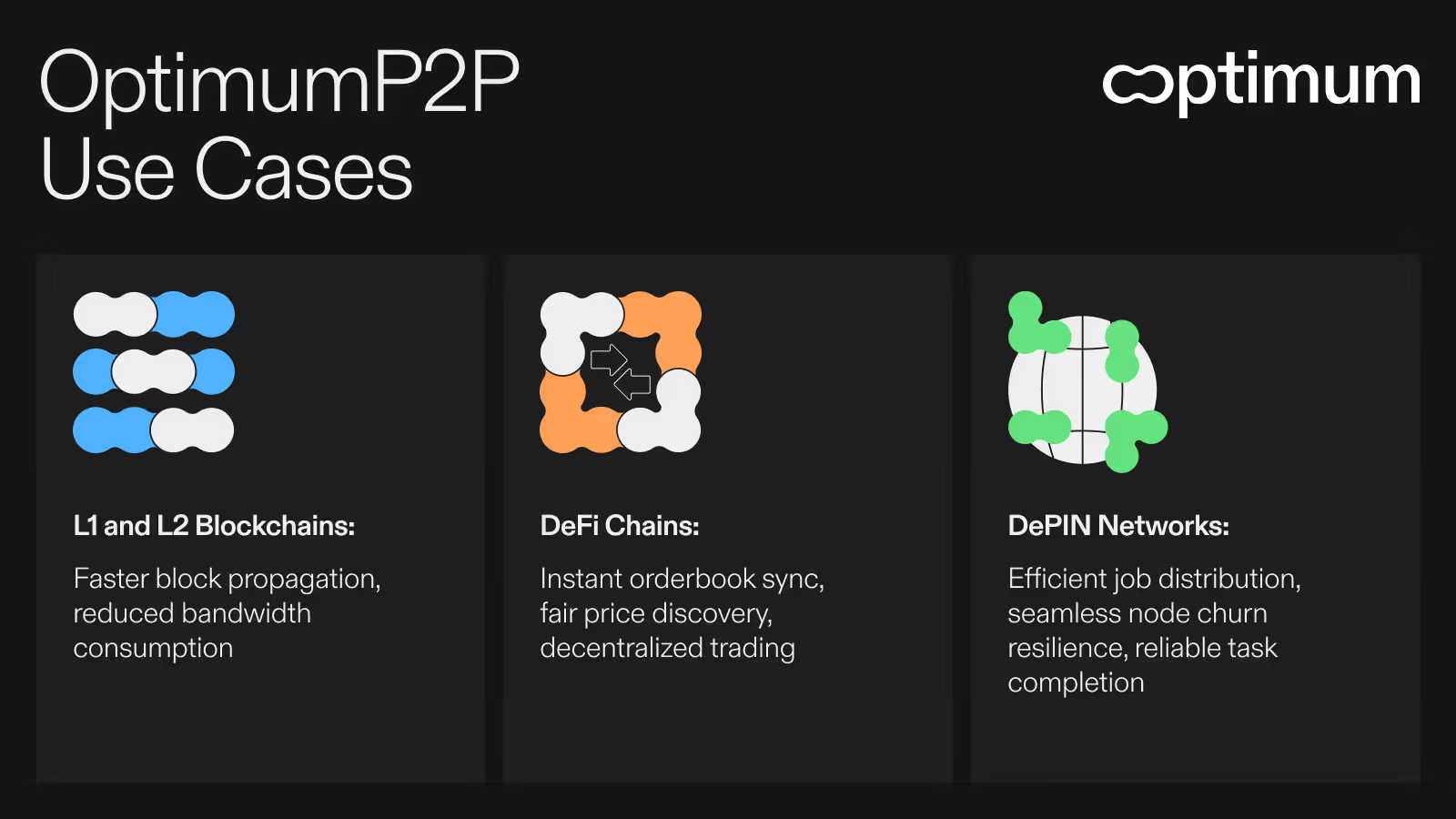
Beyond base-layer performance gains, specialized chains and use cases such as DeFi and DePIN, face unique bandwidth intensive demands. mumP2P’s coded propagation delivers the reliable and efficient synchronization these ecosystems need to thrive.
DeFi Chains
Central Limit Order Books (CLOBs), High-frequency trading (HFT), and automated market maker (AMM) protocols depend on sub-second propagation of orderbook and trade updates:
Ultra-High Throughput: Transmit massive volumes of order-book and trade updates in parallel, effortlessly scaling to meet peak trading demand.
Minimal Latency: Deliver every update in under 100 ms (and often under 50 ms regionally), ensuring traders see fresh prices almost instantly.
Seamless User Experience: Faster, more consistent updates translate directly into smoother trades, fewer errors, and greater confidence for both retail and institutional users.
Decentralize to Scale: Scale out without sacrificing speed or reliability, enabling truly decentralized DeFi infrastructure that rivals centralized exchanges.
DePIN Networks
Decentralized physical infrastructure networks built on-top of blockchains demand reliable node coordination at scale:
Efficient Job Distribution: mumP2P improves coordination across GPU/compute/storage nodes.
Graceful Node Churn: As nodes join or leave, networks remain resilient, avoiding data loss without sacrificing performance.
Improved Task Completion: Higher performance and reliability means more consistent, timely responses for decentralized services.
Some of the DePIN use cases that stand to benefit include compute networks, IoT platforms, sensor mapping, and web data scrapers & aggregators.
DeFi and DePIN are two great examples (and there are quite a few more to explore) of specialized ecosystems which face acute data-intensity and latency demands that traditional gossip cannot meet. mumP2P’s coded propagation delivers the predictable high-performance these verticals require, unlocking new application possibilities and stronger user experiences. As data demands increase and chains need to scale, mumP2P isn’t just an alternative data propagation channel – it becomes essential infrastructure.