Free and faster Ethereum beacon block propagation
At Optimum, we believe Ethereum's network layer has room for a real leap forward, one that comes not from changing consensus, not from asking operators to take on more risk, but from making propagation faster and more reliable for everyone. Scaling a network usually means choosing between more participants and better performance, since each new node adds gossip overhead. Random Linear Network Coding (RLNC), the core technology powering the Optimum network turns that around: additional nodes add coded capacity and coverage, so a wider, more decentralized network is one where propagation gets faster rather than heavier.
Ethereum’s P2P layer deserves more attention
Ethereum is increasingly the settlement venue for institutional capital: staked ETH products, corporate treasuries, tokenized funds, and regulated trading venues that route volume onchain. These participants judge a network on execution quality and timing consistency, and both are set by how fast data moves between nodes rather than by how fast the EVM runs.
Ethereum can be much faster than it is today. Most of the recent gains have come from execution and data availability improvements. The peer-to-peer layer that moves blocks and attestations across the network has seen comparatively little change, even though it sits on the critical path of every slot. It is time to raise the networking ceiling on Ethereum. We built a protocol to do exactly that.
What we built
The first protocol on the Optimum Network is called mump2p. It accelerates block and attestation propagation across Ethereum's consensus layer, and makes propagation timing more consistent from slot to slot.
It runs as an additional channel alongside standard gossip. The node stays connected to GossipSub the whole time - mump2p does not replace it. The native path is always there underneath, mump2p simply delivers the message faster. That is why the integration risk of adopting it is low: nothing about the existing setup is removed or rerouted.
Faster blocks and attestations, free for validators
mump2p accelerates beacon block and attestation propagation. Access to these faster blocks and attestations is and will remain free for validators.
Faster and more reliable propagation is most useful when it is widely adopted. The more operators that run mump2p, the better propagation gets for everyone on the network. Free, faster, better for everyone.
Validators are the network’s first users, but not paying customers. Broad validator adoption is what produces a faster, more predictable network, and that network is what makes latency-sensitive products viable for traders, market makers, and infrastructure providers. Those are the products we intend to charge for. Free propagation for validators is what makes the rest possible.
What faster propagation unlocks
Faster propagation is not only an optimization, it creates headroom. Every millisecond a block does not spend in transit is a millisecond Ethereum can spend on something else: tighter timing guarantees, more data per slot, applications that today have to live off-chain because the network layer cannot promise them consistent delivery. Ethereum's scarcest resource is blockspace, but the value of that blockspace depends on how quickly and how predictably it reaches the nodes that verify it. That is the part we work on. We are not changing what goes into a block or who gets to build it. We are widening the channel it travels through, and a wider channel is what makes the next generation of onchain products buildable.
What we are releasing
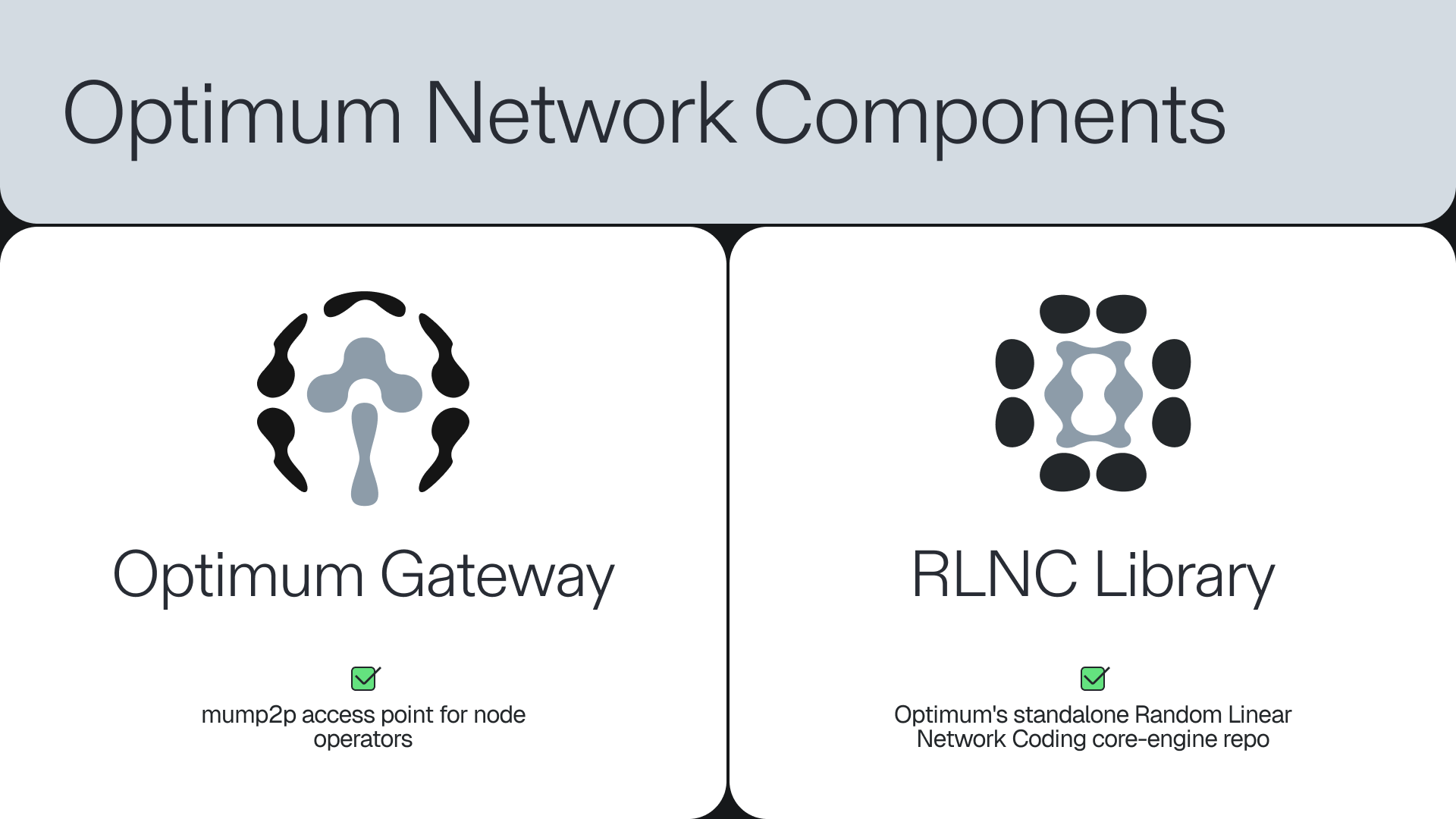
The Optimum Network is the permissionless layer we are building toward. It is still emerging, but the direction is clear: nodes should be able to join and leave freely, contribute useful work, and earn rewards for that work.
The Optimum Gateway is the product operators can use today. It accelerates Ethereum beacon block propagation through mump2p. It is free and open source. Anyone is free to inspect it, fork it, or build something different, whether that’s a sidecar, client, dashboard, or tool.
Today, operators are able to connect their gateway to the network via an API key. Generating an API key will be self-served through Optimum Console, which will be publicly available next month.
The RLNC library the gateway calls to interact with the Optimum Network is different. It will be source-available: it can be inspected, audited, and researched. It cannot be forked, nor can the technology be reused. We state this distinction plainly and explain the reason behind it in the next section.
The research behind Optimum
The core technology of Optimum comes from a massive body of university research in network coding, backed by eight figures in funding, dozens of patents, and over a decade of work led by Optimum CEO Muriel Médard.
These patents are primarily held by universities including MIT, Harvard, National University of Ireland, among others, not by a corporation.
Under the Bayh-Dole Act, universities keep the patents on the publicly funded research they produce, so they have the incentive and the means to keep producing it. Fellow MIT-born technologies like RSA set this precedent. The university research that created that technology became widely used infrastructure through licensing, commercialization, and continued reinvestment into research and education.
The bulk of the intellectual property rights flows directly back into the non-profit mission of universities. It funds the education of the next generation of engineers and computer scientists. It funds research for the next horizon in technology.
Optimum is not a big corporation extracting rent. Optimum holds an exclusive license to the RLNC technology in Web3 but we do not get it for free. We have to pay for it.
We aim to keep the product as simple and as open as we can, while honoring the obligations and responsibilities we owe to the universities behind the technology and building a sustainable business model.
What about open source?
We understand the instinct. In crypto, openness matters. We share that instinct, which is why everything we ship can be read and audited in full.
There is also a practical question: how does high-value research make its way into public infrastructure? If intellectual property is treated as off-limits to Web3, the ecosystem doesn't get more open. It cedes ground to whoever is willing to pay to keep the technology private.
So this is the trade we made. We accept a license we pay for and, in exchange, decades of network coding research becomes public Ethereum infrastructure that any validator can benefit from for free and any researcher can audit.
Our journey to becoming permissionless
Our goal is to build a network where any operator can run a node, contribute propagation capacity, be rewarded for useful work, and step away again without a central authority controlling participation.
Early in our journey, we focused on establishing whether this vision could work technically. In our 2025 paper OptimumP2P: Fast and Reliable Gossiping in P2P Networks, we described the RLNC-based gossip protocol behind the network and RUGBY, a pollution-avoidance protocol for peer-to-peer environments. If more independent contributors are going to improve propagation, the network also needs ways to keep propagating useful data when some peers are faulty, unreliable, or adversarial.
Today mump2p is in the process of being implemented on Ethereum mainnet with a group of 40+ enterprise-grade validators and node operators. The network is permissioned for now: operators connect using an API key issued by Optimum, which lets us guarantee a secure and stable network for the operators who already use it. This controlled phase is a step toward permissionless onboarding, where any participant can join or leave without intervention from us.
Join us
That is the roadmap we are building toward: a free, open-source gateway today, running on a source-available, licensed RLNC implementation underneath it. Our ultimate goal is a permissionless Optimum Network where more independent contributors mean better geographic and topological coverage, resulting in faster, more resilient propagation for everyone.
A faster, more consistent P2P layer is something the whole network benefits from. We want to build it with the operators, researchers, client teams, and Ethereum contributors who care about that outcome too.
If you run validators on Ethereum, connect to the gateway and you will be able to see your propagation metrics and mump2p’s impact instantly in the console dashboard. If you are an EtherFi operator, you have probably already received all the relevant information to begin onboarding. If you are a Lido operator, please start on Hoodi first here.